Klondike
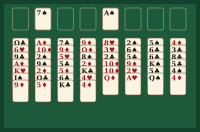
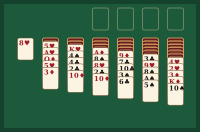
Klondike is the game most people picture when they hear the word patience: seven columns, a stock in the corner and four Aces to set free. Choose Draw 1 for a relaxed game or Draw 3 for a real test.
How to play Klondike
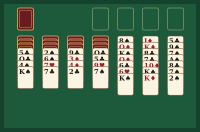
Klondike uses one pack of 52 cards. Twenty-eight of them are dealt into seven columns: one card in the first column, two in the second, and so on up to seven. Only the last card of each column lies face up. The other 24 cards form the stock.
The aim is to move all 52 cards to the four foundations, one for each suit, building up from Ace to King.
- In the columns, build down in alternating colours: a red 6 on a black 7, a black Jack on a red Queen.
- A face-up run that follows this rule moves together. When a column's last face-up card leaves, the card underneath turns over by itself.
- Only a King, or a run that starts with a King, may go into an empty column.
- Tap the stock to turn cards onto the waste: one at a time in Draw 1, three at a time in Draw 3, where only the top card of the waste can be played.
- When the stock runs out, tap it again to turn the waste back over. In this parlour you may go through the stock as often as you like.
- A card on a foundation may be brought back down to a column when that helps.
Drag a card or a run to move it, or tap it: the table picks the best place. Double-tap sends a card straight to its foundation.
Strategy and tips
Turn over hidden cards first
Twenty-one cards start face down, and each one is information you do not have yet. When two moves look equally good, choose the one that turns a card over, and prefer the column with the most hidden cards. The seventh column starts with six of them.
Do not empty a column without a King to fill it
An empty column accepts only a King. Clearing one is worth the effort when a King, ideally with a run on it, is ready to move in. Otherwise you have simply lost a column to build on.
Pick the King that suits the cards you need
If a red King and a black King could both fill a gap, look at what is waiting. A black Queen needs a red King; a red Jack needs a black Queen. Choose the colour that frees the cards you need most.
Do not rush cards to the foundations
Aces and Twos belong at home straight away, and the table sends safe cards up for you. A 6 or 7 sent up too early, though, may be the very card you needed to hold a red 5. Before you move a middle card home, ask whether anything in the columns still wants it.
Draw 3 is its own game
With three cards turned at a time, only every third card of the stock is reachable on a pass. Each card you play off the waste shifts the rhythm, so the cards you see next time change. Sometimes the right move is to take a card from the waste purely to bring a different card into reach.
Questions and answers
Can every Klondike deal be won?
No. Some deals cannot be won however well you play, because the cards you need are buried in the wrong order. Every numbered Klondike deal in our library has been won by a solver that sees all the cards, so each of those can be won, though not always by the obvious line. The daily deal is checked the same way on almost every day.
What is the difference between Draw 1 and Draw 3?
In Draw 1 you turn one card from the stock at a time and can see every stock card on each pass. In Draw 3 you turn three and can play only the top one, so many cards stay out of reach until the order shifts. Draw 3 is much harder: our solver won 15 of the 24 Draw 3 deals it tried, against 25 of 34 for Draw 1.
How many times can I go through the stock?
As many times as you like, in both versions. The move counter keeps score of how efficient you were.
Why is it called Klondike?
The name points to the Klondike region of Canada's Yukon, famous for its gold rush in the 1890s. In Britain the game is often simply called Patience.
Numbered deals
Klondike (draw 1)
All Klondike (draw 1) deals (25) →